
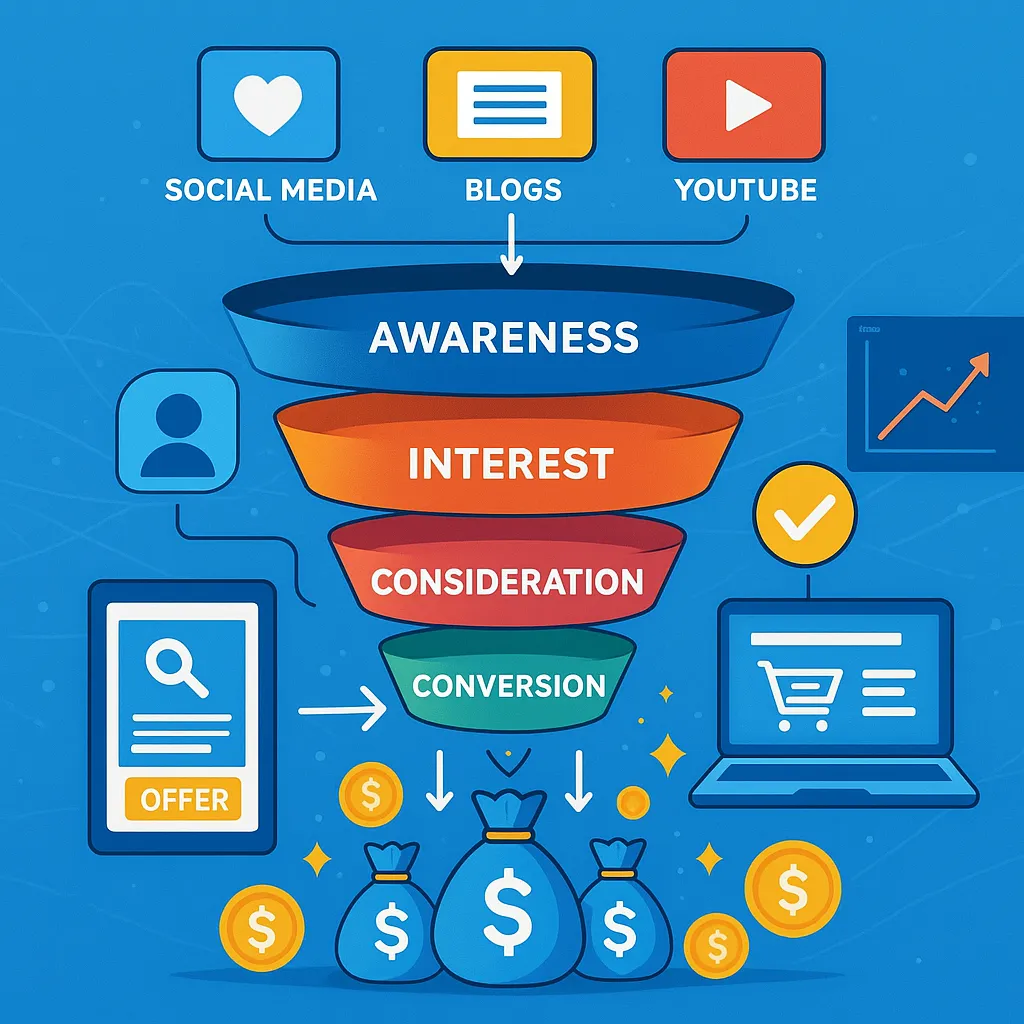

How Does an Affiliate Marketing Funnel Work to Convert Leads Into Sales?
How Does an Affiliate Marketing Funnel Work to Convert Leads Into Sales?
Direct Answer: An affiliate marketing funnel works by guiding potential customers (leads) through a structured sequence of steps—from initial awareness to final purchase—using targeted content, offers, and follow-ups. Each stage of the funnel is designed to build trust and prompt action, increasing the likelihood of converting leads into sales for the merchant.
What Is an Affiliate Marketing Funnel?
Definition: An affiliate marketing funnel is a strategic process that affiliates use to attract, engage, and convert website visitors or prospects into paying customers for a company or merchant, earning commission on resulting sales.
Affiliate: An individual or company promoting another brand’s product for a commission.
Funnel: A step-by-step pathway guiding prospects towards taking a desired action, such as making a purchase.
Conversion: When a lead completes the desired action (e.g., buying the affiliate product).
Lead: A potential customer identified by the affiliate.
How Does an Affiliate Marketing Funnel Convert Leads to Sales?
The funnel works by moving prospects through curated content and engagement steps, earning their interest and trust, and presenting affiliate offers at optimal moments to boost conversions.
Stages of an Affiliate Marketing Funnel
Stage
Purpose
Example Action
1. Awareness
Introduce the product and collect leads
Blog post, ad, or social media attracting attention
2. Interest
Capture attention and drive engagement
Offering a free guide or webinar in exchange for email
3. Consideration
Educate and nurture the lead
Email sequence explaining product benefits and use cases
4. Decision
Persuade to purchase via affiliate link
Discount, testimonial, or personalized recommendation
5. Action (Conversion)
Lead makes a purchase
Completing the purchase using affiliate link
What Are the Typical Steps in an Affiliate Marketing Funnel?
Attract Traffic: Use SEO, social media, YouTube, or paid ads to bring visitors to your content.
Capture Leads: Convert visitors into leads by offering value, such as a free ebook, checklist, or resource in exchange for their email.
Nurture Leads: Send helpful emails, product information, and case studies to build trust.
Present Offers: Introduce the affiliate offer at the right time, highlighting how it solves the visitor’s problem.
Convert Into Sales: Use persuasive calls to action (CTAs) and incentives to encourage purchase via your affiliate link.
Follow Up: Continue to engage customers post-purchase to encourage repeats, upsells, or referrals.
Key Concepts and Entities in Affiliate Marketing Funnels
An effective affiliate funnel draws on digital marketing strategies, psychological principles, and optimization skills. Key concepts and related entities include:
Affiliate Networks (e.g., ShareASale, CJ Affiliate): Platforms connecting affiliates with merchants and tracking sales attribution via affiliate links or cookies.
Email Marketing: Essential for nurturing leads through personalized content and follow-ups.
Landing Pages: Optimized pages designed to capture leads or drive affiliate offers.
Call-to-Action (CTA): Strategic prompts that guide visitors toward clicking affiliate links.
Conversion Rate Optimization (CRO): Tactics that maximize the percentage of leads who become customers.
Why Do Affiliate Funnels Increase Sales?
Affiliate funnels break down the buyer’s journey into manageable steps, reducing friction and addressing objections. By delivering the right message at the right time, affiliates can pre-sell the audience and help drive higher-quality traffic to the merchant’s offer, leading to improved sales conversion rates.
How Do Affiliates Capture and Nurture Leads?
What Tools Are Used to Capture Leads?
Opt-in forms or pop-ups on content pages
Lead magnets like downloadable guides, checklists, or tutorials
Webinars and free online courses
How Are Leads Nurtured?
Email autoresponders with valuable, educational content
Segmentation for personalized messaging
Retargeting ads or social proof (reviews, testimonials)
How Are Affiliate Offers Presented for Maximum Conversions?
Affiliates use a mix of content marketing, storytelling, comparison reviews, video demonstrations, and real-life use cases to present offers. Strategic placements, such as buttons, banners, direct product recommendations, and leveraging scarcity (limited-time discounts), help motivate leads to act.
Affiliate Funnel Example
Lead reads a blog post on “Best Fitness Trackers 2024.”
They opt-in for a free “Fitness Tracker Buyer’s Guide.”
Receive a series of emails comparing top models, sharing success stories, and providing user tips.
Email highlights a top recommended tracker with a special affiliate discount link.
User clicks the link and makes a purchase, affiliate receives commission.
What Are Common Questions About Affiliate Marketing Funnels?
1. How do you build an effective affiliate marketing funnel?
Start by understanding your target audience’s needs, create valuable content that attracts them, use lead magnets to capture emails, send helpful follow-up emails, and recommend relevant affiliate products with clear calls to action.
2. What is the difference between an affiliate funnel and a sales funnel?
Both guide prospects through a series of steps toward conversion, but an affiliate funnel is tailored to promote third-party products for commission, while a sales funnel typically sells your own products or services directly.
3. Do all affiliate marketers use funnels?
Not all affiliates use formal funnels, but those who do generally achieve better results. Funnels help capture and nurture leads rather than relying on random clicks or one-off traffic.
4. What software tools help with affiliate funnels?
Popular tools include ClickFunnels, Leadpages, ConvertKit, ActiveCampaign, and email autoresponder platforms. These help build landing pages, capture leads, automate emails, and track conversions.
5. What’s the best content for each stage of the affiliate funnel?
Awareness: Informational blog posts or videos
Interest: Educational content, checklists, or webinars
Consideration: Product reviews, testimonials, and comparison guides
Decision: Discounts, bonuses, or case studies
Action: Clear CTA and purchasing recommendations
6. How long does it take for a lead to convert through an affiliate funnel?
It varies by niche, product price, and funnel quality. Some leads convert within minutes, while others may take days or weeks as they receive nurturing emails and additional information.
7. How can affiliate funnels be optimized for higher conversion rates?
Test different headlines, offers, CTAs, landing pages, and email sequences. Include social proof, address objections, and segment your audience for more personalized recommendations.
Summary: The Role of Funnels in Affiliate Marketing Success
An affiliate marketing funnel is a proven framework that helps affiliates turn interested visitors into paying customers through a step-by-step process. By combining lead capture, nurturing, and strategic product recommendations, affiliates maximize their earning potential and provide genuine value to their audience. Whether you’re an experienced affiliate or just starting, mastering the funnel approach is key to scaling your affiliate marketing business in today’s digital ecosystem.
“`