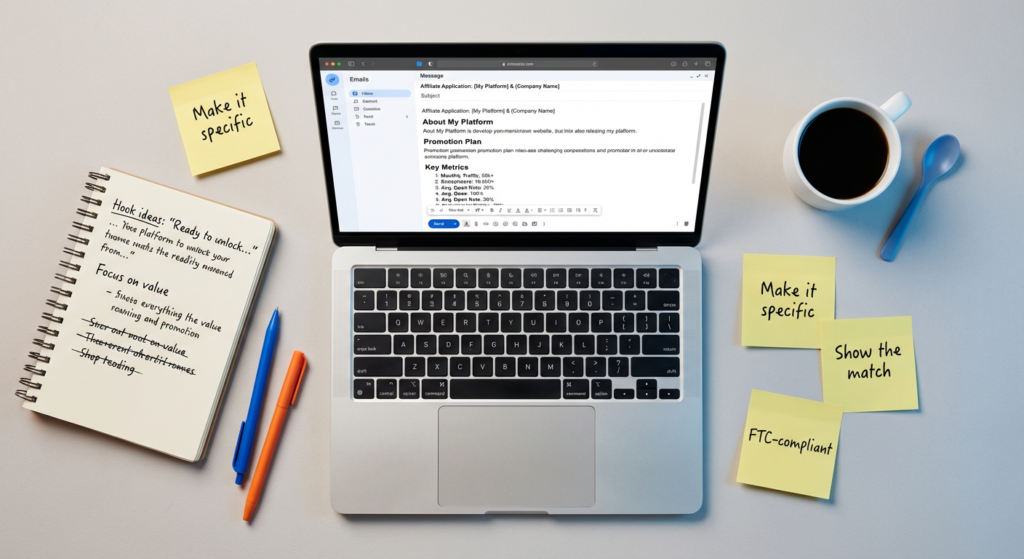

Look, I’m going to be straight with you.
Most people who apply to affiliate programs get ignored. Not because they’re unqualified. Not because their site isn’t good enough. Not because the affiliate gods are conspiring against them.
They get ignored because they sound like everyone else.
And “everyone else” sounds like this: “Hi, I love your products and would love to promote them on my website and social media channels.”
That email gets deleted before the affiliate manager finishes reading the first sentence. I promise you.
Here’s the thing — affiliate managers are busy people. They’re wading through a pile of applications that all look exactly the same. Your job isn’t to impress them. Your job is to make their decision easy. Show them the match. Hand them the yes on a silver platter.
That’s what we’re doing today. I’m going to show you the exact structure I use, give you three copy-paste templates, and walk you through real examples so you can see how this actually works in the wild.
Let’s get into it.

Why You’re Getting Rejected (And It’s Not What You Think)
Here’s what nobody tells you about affiliate applications: the manager wants to approve you.
Seriously. Their job is to build a roster of affiliates who drive sales. Every rejection is a missed opportunity for them too. So when they say no, it’s because your application made it impossible to say yes.
Here’s what’s killing applications:
You’re being vague. “I’ll promote you on social media and my blog” tells them absolutely nothing. It’s the application equivalent of showing up to a job interview and saying “I’m a hard worker.” Okay, cool. So is everybody.
You skipped the numbers. No traffic data. No subscriber count. No engagement rate. Nothing. You just left that field blank and hoped for the best. They didn’t fill in the blank with something generous, I promise.
Your niche doesn’t match. If you run a blog about classic cars and you’re applying to a luxury skincare affiliate program… they noticed. And they moved on.
Your site isn’t ready. Five blog posts and a stock photo header is not a media property. It’s a hobby. Apply when you’re ready.
You sound like a bot. Generic. Copy-pasted. Zero personality. Zero specificity. They can smell it.
You tripped a compliance wire. The second you mention paid search on their branded keywords, coupon stacking, or incentive traffic — it’s over. Immediately.
The good news? Every single one of these problems gets fixed by writing a better application. Which I’m about to show you how to do.
What These People Actually Want (It’s Simpler Than You Think)
Forget the idea that you need a massive audience to get approved. You don’t.
I know affiliates doing serious numbers with tiny, hyper-focused audiences. A food blogger with 8,000 readers who are obsessed with gluten-free cooking is more valuable to a GF meal kit company than a lifestyle blogger with 200,000 followers who covers everything from travel to tax prep.
It’s about fit. That’s the whole game.
Here’s what makes an affiliate manager light up:
Your audience looks like their customer. Not just “people who buy stuff online.” Their specific customer. Show them the overlap.
You have an actual plan. Not vibes. A plan. “I’ll write an SEO review targeting this keyword, send it to my list of X subscribers, and pin it on Pinterest” is a plan. “I’ll share it on my platforms” is not.
Your content is good. Link to something you’ve written that actually converts. Show them you know what you’re doing.
You’re not going to embarrass them. Mention FTC compliance. Seriously. Just say “I follow FTC disclosure guidelines.” Ninety percent of applicants don’t, and it makes you look like a professional in a room full of amateurs.
That’s it. That’s the whole list. Now let’s build the application.
The Six-Part Formula That Gets You Approved
Every application I write — whether it’s a form field or a cold email — has these six pieces. In this order. Every time.
1. The Hook. One or two sentences. Who you are, why you’re reaching out to this program specifically. Not every program. This one. Reference something real — a product you use, a value you share, something you actually know about them.
2. Your Platform and Audience. Where you publish. How many people show up. Who they are. What they care about. Give them the numbers — monthly readers, subscribers, follower count, whatever you’ve got.
3. The Match. This is the most important part of the whole application. Why does your audience want their product? Connect the dots explicitly. Don’t make them figure it out. Spell it out.
4. The Promotion Plan. What are you actually going to do? Which content, which channels, which timeline? Be specific enough that they can picture it happening.
5. Past Results (If You Have Them). Worked with other affiliate programs? Share a number. Even a rough one. “My last affiliate review drove around $400 in commissions in the first month” is worth more than ten paragraphs of promises.
6. The Close. Short. Confident. Not desperate. Include your URL. Done.
Simple, right? Now let’s put it to work.
GET YOUR FREE CHECKLIST HERE
The Three Templates (Use These Word for Word — Just Fill in the Blanks)
Template 1: The Form Field Application
This is for the “tell us about yourself” and “how will you promote us?” fields on ShareASale, Impact, or a brand’s own portal.
About My Platform: My name is [Your Name], and I run [Site Name] ([URL]) — a [niche] blog for [audience type]. I publish [X] posts a month and reach [X] monthly readers, most of whom are [specific demographic detail].
Why [Brand Name]: I’ve been a [Brand Name] customer since [timeframe] and have already recommended [specific product] to my readers. Your focus on [brand value] is exactly what my audience looks for before making a purchase decision.
My Promotion Plan: Here’s specifically how I’ll promote [Brand Name]:
- A dedicated SEO review targeting “[keyword]” — around [X] monthly searches
- A feature in my monthly newsletter ([X] subscribers, [X]% open rate)
- [Optional channel] content featuring [product]
I comply fully with FTC disclosure requirements and have promoted similar offers including [example if applicable].
[Your Name] | [URL] | [Email]
Template 2: The Cold Outreach Email
Use this when there’s no public application form, or when you want to go straight to the partnership manager.
Subject: Affiliate Partnership — [Your Site] + [Brand Name]
Hi [Name],
I’m [Your Name], creator of [Site Name] — a [niche] resource for [audience description]. I’ve been following [Brand Name] for [timeframe] and I think there’s a real match here worth talking about.
My audience of [X monthly readers/subscribers/followers] is made up of [demographic + interest]. They’re actively researching [product category] and I get questions about [pain point Brand solves] on a regular basis.
Here’s what I’d do specifically:
- Content: A long-form SEO review of [specific product] targeting “[keyword]”
- Email: A feature in my newsletter ([X] subscribers, [X]% open rate) within [timeframe]
- Social: Posts to my [X] followers on [platform]
I’ve worked with [Partner A] and [Partner B] before and I know how to drive traffic that converts — not just clicks.
Is there an application I can fill out, or would a quick call make more sense? Happy to go either way.
[Your Name] | [URL] | [Email]
Template 3: The Comeback Email
Got rejected before? Here’s how you come back after you’ve leveled up.
Subject: Following Up on My [Brand Name] Affiliate Application
Hi [Name],
I applied to the [Brand Name] affiliate program back in [month/year] and was declined. I’m reaching back out because things have changed significantly since then — and I think the fit is a lot stronger now.
Here’s what’s different:
- Traffic is up from [X] to [X] monthly readers ([X]% growth)
- I’ve published [X] new pieces in the [niche], including [strong post title/topic]
- My email list is at [X] subscribers with a [X]% open rate
- I’ve since partnered with [affiliate program] and driven [result]
[Brand Name] is still a brand I genuinely want to work with. My audience asks about [product category] constantly, and [specific product] is the best answer I have for them.
I’ve linked my top content and traffic overview below. Would love to be reconsidered.
[Your Name] | [URL] | [Email]
The Unwritten Rules (Don’t Skip This Part)
Templates are only half the equation. The other half is not screwing up the stuff nobody talks about.
Don’t apply with a thin site. Fifteen to twenty quality posts minimum before you go after competitive programs. Five posts is not a website. It’s a draft.
Read the requirements first. Some programs have traffic minimums. Some only want certain content types. Two minutes of research saves you a wasted application.
Don’t lie about your numbers. They check. SimilarWeb, SEMrush, Ahrefs — takes thirty seconds. Getting caught inflating traffic doesn’t just get you rejected, it gets you blacklisted.
Follow up once. One time. Five to seven business days, one polite nudge. After that you let it go. Managers have long memories for annoying applicants.
Personalize everything. I know it takes longer. Do it anyway. One specific reference — a product, a campaign, a shared value — completely changes how the application reads.
Never trash the competition. “I promote [Competitor] but yours is better” sounds disloyal. Because it is. They’re imagining you saying the same thing about them someday.
Let Me Show You What This Looks Like for Real
The Food Blogger
Sara runs PlantForward Kitchen — a vegan recipe blog with 12,000 monthly readers. She’s applying to a plant-based meal kit company.
Here’s what she wrote:
“My name is Sara, and I run PlantForward Kitchen, a vegan recipe blog with 12,000 monthly readers. 90% of my audience identifies as fully vegan or vegan-curious, and my most-visited content covers easy weeknight meals and beginner guides for people just starting out.
I’ve been a GreenChef subscriber for eight months — genuinely love it, especially the pre-portioned ingredients. I’d love to write an in-depth review targeting ‘best vegan meal kit for beginners’ (2,400 monthly searches, low competition).
I’d also include GreenChef in my monthly newsletter (3,100 subscribers, 34% open rate) and build a Pinterest recipe board around meals I’ve actually made with your kits.
I follow all FTC disclosure guidelines and am happy to share my traffic analytics on request.”
See what she did? Real numbers. Real product experience. Named keyword. Multi-channel plan. Compliance mention. Approved.
The Finance YouTuber
Marcus runs “Broke to Budget” on YouTube. 6,200 subscribers. He’s going after YNAB.
“Hey YNAB team — I’m Marcus, creator of Broke to Budget (6,200 subscribers). I make videos about budgeting for people in their 20s dealing with student debt and entry-level salaries.
YNAB comes up in my comments constantly. My viewers are already asking about it. I want to make a dedicated ‘Is YNAB Worth It?’ video — people are searching that exact phrase — walking through the setup, 30-day results, and a comparison with free alternatives.
I’ve partnered with Credit Karma for the past six months and driven consistent, compliant referrals. Happy to share that data.”
Audience proof. Specific content idea. Keyword awareness. Existing affiliate track record. That’s a yes.
Here’s the Bottom Line
Getting approved isn’t some mysterious art form. It’s communication.
Affiliate managers want partners who will actually move the needle and not cause problems. Show them you’re that person — with real numbers, a real plan, and a real reason why your audience is their customer — and the approval rate goes way up.
Pick one program you actually care about. Take the template that fits. Spend twenty minutes making it specific and human. Send it.
Then come back and do it again with the next one.
That’s it. That’s the whole system.
Want more on this? I’ve got guides on [picking the right affiliate programs], [writing product reviews that actually convert], and [affiliate marketing from scratch] — check those out next.


Thanks for reading and diving into these templates! I created this guide to help more aspiring affiliates move past generic applications and actually get noticed. If you’ve had success—or struggles—getting approved for programs, or if you have a favorite outreach tip that’s worked for you, share it below. Let’s swap stories and help each other land those “yes” replies!